This one has been a long time in coming. It has taken me awhile to sort out the ideas. Many of you are familiar with small group instruction in reading and math. This type of small, needs-based grouping is an essential element in most elementary classrooms. However, when I was asked to consider this same idea for elementary science, it was uncharted territory. Sure, we've all done group work. Everyone builds the same windmill or does the same experiment. I need to be clear. The goal is to have each group or each student working on something that meets their needs. Before you go and get the pitchforks and torches, I am not advocating for there to be multiple hands-on experiments going on at the same time. That would create a potentially unsafe environment. Someone would lose an eyebrow.
However, consider this, what if we grouped students by their needs in science by using the results of rigorous pre-assessment. In my world, that is a combination of traditional multiple choice and constructed response type questions which needs to include questions on prior knowledge. It would also include some sort of performance based pre-assessment. These performance pre-assessments would emulate the end of unit performance assessment.
In our NGSS curriculum, these are either a physical object and in some cases it is based on developing an explanation (verbal or written). In either case, the result is the teacher receives data on what the students already know. This then allows students to be grouped based on their needs. For the most part, this would only impact the depth and complexity of the final product the group creates. What we must avoid is the age old trap of grouping kids so that there is a "leader" in the group who can teach the rest of the students. Where is this "leaders" opportunity to grow? Let's also be honest in the probability that this leader does most of the work for the other students. Where is there opportunity to learn?
Part two goes from the group level to the individual student. One of the main benefits to going one-to-one is the capacity to serve out a variety of learning objects (video, audio, image, interactive media, etc.) A number of vendors produce products of this type, but I painted myself into somewhat of a corner. With my dogged insistence on locally relevant storylines, no one provider produces learning objects specific to the needs of our curriculum.
With many of the units, I have created eBooks which package related content into one learning object. I have used a package called SoftChalk. It is essentially a WYSIWYG webpage creation tool. I am able to find and organize content from our providers and external sources. These eBooks also help reduce teacher workload. Rather than ten learning objects a teacher has to send to students, they only have to send one. Students can then choose the object they need to understand the concepts. A recent update also includes the capacity to give students immediate feedback on embedded quizzes. For each multiple choice answer, a specific learning object can be identified to provide students with the content they need at that moment.
This is a far as I have gotten so far. Would love to her other ideas.
When I started writing curriculum, I was told to tell a story. The lessons needed to be joined together in a coherent storyline. The theory was that students would learn more if they knew how the concepts were linked together. In the age of the Next Generation Science Standards (NGSS), this idea is amplified further with the addition of engineering design challenges. Not only do the lessons need to connect, but they need to connect towards solving a problem. As an example, I will walk you through a unit was just updated.
The performance expectations for this unit are from the grade four topic page "Earth Systems: Processes that Shape the Earth". Maryland has some diverse geological features, but rarely do we have any that cause a disaster. In 2011, we did have an earthquake that registered 5.8 on the Richter Scale. That is pretty much an extreme for us. So, if I wanted to have local natural disaster, I would have to get creative.
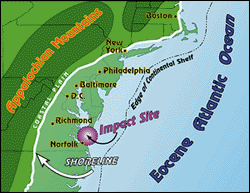
As it turns out, Maryland has had some significant geological events. The most significant happened 35 million years ago. A bolide roughly four kilometers across smashed into the shallow waters in what would be the southern tip of the Delmarva Peninsula. The super heated winds created a hypercane which vaporized everything within 1000 km. The splash resulted in a tsunami which traveled to the Appalachian Mountains.
The story of the crater's discovery played very well into the performance expectation on changes in landscape over time. The crater cannot readily be seen on the surface. After 35 million years, erosion and sedimentation have erased most of the evidence (4-ESS2-1 and 4-ESS2-2). Some of the conclusive evidence which identified the age of the impact conveniently was the result of fossil evidence (4-ESS1-1). That leaves students having to develop ways to minimize the impact of Earth's natural processes.
Now, what I originally wanted to do was have students plan for another meteor impact. In 2880, another meteor is projected to come close enough to Earth where it MAY impact. NASA has some great simulations showing the potential for an Atlantic impact. However, apparently nine year olds would be sensitive to that even though it is well into the future. So, I had to find an oxymoron- a non-threatening natural disaster. As it turns out, the Canary Islands provide one.
The island of La Palma has a slab of rock that may slide off into the ocean and cause a tsunami wave which could impact Maryland. There was a story picked up by the media several years ago that over hyped a projected model. A great lesson in science all by itself.
After discussing how models can be used improperly, we talk about more realistic impacts from waves and equate them to some of the hurricane storm surges Maryland gets. We go from mega-disaster to survivable threat. The students are then tasked with build a tsunami resistant house. I really liked the version from Teach Engineering. I did modify the design a bit. I went with a 1'x1' ceramic tile as my wave generator rather than a piece of sheet metal duct taped to the bottom of the tub. Also, rather than pushing the tile down, I pull up. It produces a much more consistent wave.
My first field test with NGSS based curriculum has concluded. By the numbers, I had fifty-six classroom teachers and around 1100 students participate (demographic breakdown below). This represents five percent of the total K-2 population. It included students in behavioral programs, severely disabled students, and approximately 40% FaRMS.
So, what do I know now:
Teachers need to understand the performance expectations. Without the "why" they focused on the "what". See my previous post on unpacking the standards down to learning goals and success criteria.
Creating videos of teachers implementing the curriculum is time consuming, but highly valued. Being able to watch another teacher do what you are about to do builds confidence. I need to work on quality control, but it is a start.
Online assessments don't work very well when students are just learning to use computers. While every student in the field test had a computer, it took them three months to get agile with it. There are also significant technical challenges that need to be overcome before these assessments are truly viable.
Performance assessments get the most "bang for the buck". They are also a great way to keep students engaged in learning when they know they get to apply what they have learned to solving a real-world, local problem.
Don't expect teachers to be comfortable with NGSS based curriculum the first time they teach it. It will have to grow on you.
What do the kids think? I took a risk this year and created a survey to allow students to comment back about their experiences in the curriculum. Keep in mind that these were K-2 students. The majority of responses came from grade 2. I copied the text based responses into Wordcloud .
What do you want to change?
Note: The word "nothing" was removed as it overshadowed the other words
What did you like?
The words beach, wall, and flower are referencing the three units for grade 2. You can get a full overview of all the K-2 units in my previous post.
What's next?
The field test for grades 3-5 is next. I just wrapped up the professional development for that on Thursday. Great group of teachers hung out with me in a rather sultry and odoriferous elementary school. We covered the big parts to the first two units. This included a large amount of time discussing scientific argument using the CER model and the KLEWS strategy. We used the spandex model of the universe as our scientific phenomena. That's right I introduced General Relativity to elementary teachers and it is part of our grade 5 unit on space. I blame the folks who developed the NGSS. They are the ones who put gravity in with the motion of objects in the universe. I had to find a way to connect the two to maintain a good storyline. I encourage you to build this model for yourself. It is awesome!
A subsequent professional development will occur in December for the last two. I will have roughly equivalent numbers of teachers participating this year but with a lot more students. In grades 3-5, almost all the teachers departmentalize.
Next, I move forward with K-2 for the entire system. Our board of education saw fit to approve the purchase of materials for all K-2 teachers. That will be the largest purchase order I have ever signed. My thanks to them for their support.
In July, a small group of K-2 field test teachers will update the curriculum based on feedback from this year. That will be a very interesting two-week process.
Lastly, I will also be conducting professional development en masse in August. 1200 teachers in one day. I provided an outline of the plan in a previous post. The reality of PD at this scale is just now setting in.
Apologies for the delay between posts. I have not forgotten about my promise to expand more on small group instruction in the elementary science classroom. The responses to the webinar really moved me down the path and there have been some technical solutions that I believe, under the right circumstances, can lead to needs-based, small group instruction in the elementary classroom. I promise a post is forthcoming.
The focus of this month's blog is really about what happened last month. My May was bookended by two graduations. My oldest daughter graduated from Shippensburg University, my Alma Mater, with a degree in Geoenvironmental Studies. Her senior project (click on the image to see the full poster) is based on a love of geology that started as a little girl with piles of rocks accumulated in her room. She is looking for job if anyone is hiring.
My youngest daughter graduated from high school with a 4.02 GPA, and a balance between the arts and sciences that is rare- a real STEAM prodigy! She will be attending the University of Maryland-College Park this fall where she was accepted into their architecture program (a picture she was thoroughly embarrassed by, which is why I posted it).
While I am doubtlessly proud of both girls, I have been asked on countless occasions how I got two girls into STEM related careers. I will be the first to say that it had as much to do with my wife as myself. The sad thing is that a two parent household is increasingly a rare occurrence. This is not to diminish the work single parents do everyday raising their kids, but I recognize the advantage it brought to my girls.
Second, my children were marinated in science from an early age. I am reminded of the last year's Verizon commercial (shown below). My wife and I did not deter our daughters from engaging in science, getting outside, or getting dirty. My wife and I have the means to provide experiences. Another advantage my children had.
That also meant not allowing either to back down when things got tough. Whether that was AP Calculus or hydrology, perseverance is alive and well in both girls. Notice I did not say grit. Recent research points to luck or cultural advantages as the likely the roots of success.
Lastly, my wife and I model the value of lifelong learning. For as long as my children can remember, either my wife or I have been taking classes, teaching, or graduating from college with our own degrees. This value of learning is not shared by all families. Not because they don't want to, but because they need to provide food on the table, pay bills, and hope the funds make it through the month or week. In this case, it is the advantage of having time to consider additional schooling instead of finding basic needs on a daily basis (that is until the college loan bills start pouring in).
So where am I going with this post? Part of it is to brag on my daughters. How often does a father get two graduations at a time! The other part is focused on the advantages my children have because of the privileges my culture and country provide.
Over the last several years, my system has been grappling with the achievement gaps that continue to grow. These gaps are present within races and low soci-economic classes. I participate in monthly sessions were we've been breaking down the causes and solutions to these issues. The last session was personally difficult for me as it made me painfully aware of the advantages I have. While I could dwell in my "white guilt", I've realized the work I've done with the NGSS curriculum will at least help marinate more students in science and engineering at an early age. It is a start, but the work must continue until we can achieve "all standards for all students". It is hard for me now not to focus on the inequities that exist. As one of my trainers put it "You can't un-see once you have seen",
As I discussed earlier, my school system has 114 elementary schools. That equates to roughly 400 teachers per grade level. That means in August, I have 1200 teachers who will begin teaching the NGSS for the first time. How will I meet the professional development needs of the equivalent of an army regiment?
Let's start with the traditional face to face option. On August 17th, I will hold a half day professional learning experience for all 1200. There will be five centers, one in each geographic area. At each center, a classroom teacher who piloted the curriculum this year will lead a professional development focused on practical implementation strategies they used during the year. A session which will give them an opportunity to gain some hands-on experience from the perspective of a student. This session will be preceded by a video based professional development which digs into the inner workings of the curriculum guides.
On top of that, my staff and I have been going into classrooms all year video recording the aforementioned pilot teachers implementing the lessons. These videos are embedded in the associated lessons as "need it right now" professional development. We don't have them all, but many of them.
Lastly, is the curriculum itself. Each guide and lesson is an opportunity to improve the pedagogical and content knowledge of teachers. One thing I've learned this year as a result of writing curriculum and watching it being taught, is that the NGSS are confusing for the uninitiated. Teachers need to understand the performance expectations in order to understand why they are teaching the curriculum we wrote. As Steven Pruitt said in his top ten list , simply reading the NGSS does not mean you understand them.
To overcome this, my district has invested time in helping us understand the concepts of Learning Goals and Success Criteria. I discussed Success Criteria in an earlier post. Those are the much lauded "I can" statements. As I've worked on understanding these in the context of the NGSS, I made a pretty significant upgrade to my lesson plan structure.
The table below is the outcome of several design iterations. It starts with an engaging essential question followed by the PE. The color coded section is an hommage to the NGSS. On the left, are the learning goals. This section comes directly from the three components of the PE. These are what students are expected to understand.
This word "understand" is a difficult one. How do we know students understand something? This is where the Success Criteria come in. These are directly from the evidence statements. While these are three dimensional, they tend to learn toward one of the PE components more than another.
Below the colored section is the student friendly version. The Success Criteria are the non-negotiables. The Success Criteria (aka "I can" statements) are a starting place. They are specifically what students will do to demonstrate they understand the Success Criteria. These are negotiable. A teacher may decide that the lesson we wrote will not meet the needs of their student. They can develop their own "I can" statements based on the needs of their students.
The example below comes from the grade 5 Earth Systems topic page. As always, I look forward to your comments and questions.
Essential Question:
How is water distributed around the world?
Standard: 5-ESS2-2.
Describe and graph the amounts and percentages of water and fresh water in
various reservoirs to provide evidence about the distribution of water on
Earth.
Learning Goals(s): (based
on the components of the performance expectation)
Students will know and be able to:
Success Criteria: (based
on the evidence statements)
Students can:
Describe and graph quantities
such as area and volume to address scientific questions.
Students graph the given data
(using standard units) about the amount of salt water and the amount of
fresh water in each of the following reservoirs, as well as in all the
reservoirs combined, to address a scientific question
Nearly all of Earth’s
available water is in the ocean. Most fresh water is in glaciers or
underground; only a tiny fraction is in streams, lakes, wetlands, and
the atmosphere.
Students use the graphs of
the relative amounts of total salt water and total fresh water in each
of the reservoirs to describe that:
The majority of water on
Earth is found in the oceans.
Most of the Earth’s fresh
water is stored in glaciers or underground.
A small fraction of fresh
water is found in lakes, rivers, wetlands, and the atmosphere.
Standard units are used to
measure and describe physical quantities such as weight and volume.
Measure quantities of water
using metric units.
Student Friendly Learning Goal(s):
I understand:
Student Friendly Success Criteria:
I can:
the amount of water found in
oceans, lakes, rivers, glaciers, groundwater and ice caps can be
represented.
create a graph showing the
relative percentages of each source of water on Earth.
most of the water on Earth is
in the oceans
freshwater is distributed
unequally across the Earth
explain where freshwater can
and cannot be found on Earth in relation to where people live.
liquids are measured in
volume using liters as its unit.
measure quantities of water
to represent each source of water on Earth if all water equaled 1000
ml.
As I wait for the blizzard to end here in Stewartstown, I thought I would do another blog post about the latest unit I just completed. So let's start with the performance expectations for this unit. Using the topic based arrangement- "Space Systems: Stars and the Solar System".
Students who demonstrate understanding can:
5-PS2-1.Support an argument that the gravitational force exerted by Earth on objects is directed down. [Clarification Statement: “Down” is a local description of the direction that points toward the center of the spherical Earth.] [Assessment Boundary: Assessment does not include mathematical representation of gravitational force.]
5-ESS1-1.Support an argument that differences in the apparent brightness of the sun compared to other stars is due to their relative distances from the Earth. [Assessment Boundary: Assessment is limited to relative distances, not sizes, of stars. Assessment does not include other factors that affect apparent brightness (such as stellar masses, age, stage).]
5-ESS1-2.Represent data in graphical displays to reveal patterns of daily changes in length and direction of shadows, day and night, and the seasonal appearance of some stars in the night sky. [Clarification Statement: Examples of patterns could include the position and motion of Earth with respect to the sun and selected stars that are visible only in particular months.] [Assessment Boundary: Assessment does not include causes of seasons.]
As you may recall, the two questions I filter all curriculum through are:
Why am I doing this?
What will it help me to do?
If this is the starting point, what are the practical application for students in Baltimore County? As it turns out, there has been (and still is) a very practical application- calculating location. For hundreds of years, people have used the stars and Sun as a guide. It also turns out that Baltimore County had a local expert on the subject.
In 1731, Benjamin Banneker was born and through his own study became an expert surveyor. Eventually, his skills were recognized by Andrew Ellicot and Mr. Banneker became part of the an important survey team. The team that would eventually layout Washington, D.C.
Mr. Banneker was able to use Polaris to measure latitude and the movements of Jupiter's moons to measure longitude. The precision he was able to achieve with his tools and techniques could be measured to within a meter. For comparison, the first GPS I used for recreational purposes was +/- 3-5 meters.
So, here is how it works. Latitude is easy. Measure the angle of Polaris off the horizon using a sextant or clinometer and you have the latitude. Finding Polaris gets me into comparing star magnitudes and which stars are visible at certain times of the year. Two great resources to help show students the stars during the day. Stellarium and Celestia offer the opportunity for student to control time (#DoctorWho).
Longitude is and has historically been the chief problem. With latitude, you have a starting point called the equator. Longitude has no natural starting point. The prime meridian is an artificial starting place. However, if you know when something happens in Greenwich and can see it happen where you are, then you can find longitude by finding the difference in time.
Mr. Banneker would use an ephemeris of Jupiters' moons. The ephemeris allows the user to know when one of Jupiter's moons is coming out of eclipse. Observing Jupiter requires at least a six inch telescope. It also requires a night sky. These are problems given the confines of school hours and budgets.
For my students, we will use Solar Noon. Solar noon occurs at 12:00 only twice during the year. Beyond that, it ranges widely 16 minutes +/ - from 12:00 depending on the time of the year. This relates to the "Equation of Time". So how do you find Solar Noon? At Solar Noon, the Sun produces the shortest shadow of the day. See the complicated device (below) for measuring that shadow. This picks up the performance expectation on the length and angle of shadows.
This leaves the PE on gravity. This one took me a while to figure out. I shows up in two ways in the unit. First, I did go a little beyond the standards by asking the question "Why is everything spinning in space?" I could not resist a model which demonstrates this phenomena so elegantly.
The second way is through measuring time. Benjamin Banneker reverse engineered a clock from a pocket watch he borrowed. His hand-carved wooden clock used a simple weight pulling down on a spool controlled by an escapement to regulate time. The development of accurate clocks is what finally made it possible to measure longitude.
About six minutes into the video above, you will see the host build a clock out of raw wood pieces. I found a version of the same thing on Thingiverse. It was interesting to get it working.
In the performance assessment, students are responsible for calculating their location to the nearest full degree or about 111 km of their actual location. More importantly they have to explain how they calculated the location.
It has been a while since my last post. Actually, it seems like a lifetime ago. I will diverge from my normal discussion of science curriculum for a moment, but will bring it back around. Just stay with me.
Last July, my father was diagnosed with an extremely rare form of cancer undoubtedly from exposure to Agent Orange during his year of service in Vietnam. He was a helicopter pilot and was tasked with spraying the herbicide. He told me that due to the prop wash, he would come back soaked in it.
My father just prior to deployment in 1968.
I was out of the office almost all of November due to the complications he has endured through this process. I've learned more about the science and art of medicine in these last few months than I ever wanted to know. At one point, I found myself sitting at my father's bedside with my mother and the oncologist as we discussed treatment options. The Mayo Clinic was consulted and a treatment regime was prescribed which had been deemed effective for most patients. I say "most" because my father has a rather complex medical history. Complex enough that it should qualify him for a season of "House".
The oncologist read through the recommendations with us and reviewed my father's most recent test results. Based on these results, he decided to follow a slightly different regime. As of this posting, my father has seen a 70% reduction in the "bad cells" and we are hopeful that by the end of January to be in remission.
What are the lessons to be learned here?
A set of treatments was prescribed.
Test results prior to treatment indicated a modified, more individual course of action.
The treatment is proving to be successful.
There is an art and science to treatment.
Let's get back on the topic of this blog. My primary job, at the moment, is developing curriculum based on the Next Generation Science Standards for the throngs of teachers in my system. This curriculum is a suggested course of action. It provides many of the components needed to assist teachers in developing mastery of the standards in students. Now, I'm not comparing myself to the Mayo Clinic, but the expectation is that I am the local expert on the NGSS. Now I could complete this analogy but I think you know where I am going. Teachers are the doctors and students are the patients.
What is the purpose of curriculum? As a teacher, I lived two very different realities when it came to curriculum. As a kindergarten teacher, I had no curriculum. I based my instruction on the end of grade level expectations. I had to make up curriculum on my own. As a high school science teacher, I received curriculum from my supervisor. A three inch thick binder. Blue with a green cover as I recall. I remember looking through it and realizing that, while it had good lessons it did not meet the needs of my students. Once again, I had to make up my own curriculum, but at least I had a starting point.
The idea of following a curriculum, chapter and verse, never occurred to me. I always viewed curriculum as a guide developed by people who have a pretty good idea about what most kids need. We'll call this a science. It was then my job as a teacher to find the best fit for my students. That takes a little science and a lot of art to make that happen. Great teachers are almost poetic.
As I discussed back in October (Articulating Expectations into a Personalized Learning Environment), I outlined a new set of curriculum expectations developed by my school system. In summary, through pre-assessment, we formatively use data to diagnose where students are before instruction starts. The result is multiple groups of students consuming instruction based on their instructional need in the same room.
I would hope that the merits of small group instruction are self-evident, but consider this. In one of my prior jobs, I worked with "gifted" students. How many of these students coast through instruction they have already mastered? Conversely, how many students endure instruction for which they are not ready?
The question is, then what. How do you logistically manage a class like this. At the secondary level, there are more options. Students can take different classes. At the elementary level, it is more self-contained. A reality lost on many people outside (and some inside) education.
So, I am opening a dialogue to discuss these ideas. I am going to host a webinar on February 2 (Ground Hog Day) to develop some concrete strategies for all of us. Click on this hyperlink at 7:00 PM (EST). The rough agenda will be as follows.
I will discuss the specifics of the curriculum framework I developed (I am open to other ideas.)
Start building a set of management strategies for teachers
Think beyond the current realities of classroom instruction. Do we need a different concept of what a classroom is? What does the field of educational technology need to offer us? Do we need to "Amazonify" how students access content?
I look forward to talking with you at the webinar!
I missed my monthly update so I guess I will have to do two
in October. I wanted to talk about some
new attributes to my curriculum that have really altered how teachers and
students engage in answering the age old question “Where am I?”. I touched on this idea in July when I discussed "I can" statements.
Once we have the “I can” statements established, they are
then used to form a proficiency table. These table have filled an important void that existed in my previous curriculum. We have always offered pre and post assessments to teachers. Ostensibly, the resulting data was to assist teachers in differentiating the curriculum. However, it quickly became apparent that most teachers did not have a clear view of how to make that happen. The proficiency tables are a way to fill in that blank.
Shown below is an example for grade 3 :
LEVEL
DESCRIPTION
BASED ON
PRE-ASSESSMENT
RESULTS
UNIT
SPECIFIC
STUDENT
EXPECTATIONS
SUGGESTED
CURRICULAR
PATH
4
Pre-assessment data which
indicates students master prior knowledge/processes and current
content/process (via performance) are level 4.
I can:
Use scientific evidence to
explain how a design solution reduces the impact of weight from a
weather-related hazard such as a blizzard
Design and build a structure
to withstand the impacts (weight and wind of a hurricane and/or a
blizzard.
Students at this level
build their own structure from scratch
to withstand an additional weather-related hazard such as wind from a
hurricane and/or blizzard. They are given the parts to build the structure
and may also bring parts from home to build the structure within the
construction parameters.
3
Pre-assessment data which
indicates students master prior knowledge/processes and on grade level
content are level 3.
I can:
Explain and interpret data
presented in a table, graph, or chart
Compare weather v. climate
Predict weather based on
information presented in a graph, table, or chart
Evaluate information from
print and nonprint resources
Describe and explain how
climates vary in different regions of the world
Use patterns of change in
climate to predict typical weather conditions in different regions
Students at this level should be
given more time to conduct the investigations. The teacher
should spend less time modeling the investigation. Students can
also be given more time to design, build, and refine their structural
designs.
2
Pre-assessment data which
indicates students have mastered the prior content but does not demonstrate
understanding of on grade level content and processes are a level 2
I can:
Use print and nonprint
resources
Use data presented in a
graph, table, or chart
Identify and describe types
of weather
Identify and describe impacts
from weather-related hazards
Describe ways weather affects
our everyday lives
Work with other students to
conduct an investigation
Students are ready for grade level
appropriate content and processes with modifications as needed.
1
Pre-assessment data which
indicates students who do not understand the prior content are a level 1.
I can:
Not identify types of weather
Not understand how weather
changes from season to season
Not identify weather-related
hazards
Not identify impacts from
weather-related hazards
Not understand data presented
in graphs, tables, or charts
Students at this level should be
given the opportunity to access digital data from the weather unit from
kindergarten to build background knowledge about weather, climate, and visual
data representations.
As you move from bottom to top, students expertise increases. Ultimately, students should be ready for level 4 by the end of the unit (transferring learning to a new solving a new problem). This idea is very new to me and to my teachers. It will take a lot of refinement over the next several years to get this process "perfected".
Here is the new problem that has developed. While we are finally able to determine student levels of mastery after pre-assessment, the problem is "then what".
To be specific, imagine a classroom where you have students spread across all four proficiency levels. Three students do not have the prior knowledge necessary to engage with the grade level content (Level 1). There is one student who spent a summer at meteorology camp and is past level four. Fifteen students are ready for the curriculum as is (level 2) and the remaining nine pretty much know the content (level 3) and just need time to work on their prediction skills. That's a class of 29 if you are keeping count. What do multiple needs groups look like in science? It is very different than reading where we litterally have moving parts. If we are working towards a personalized learning environment for students, we need to develop strategies for teachers to manage it. Anyone have ideas or good references for what this might look like in the elementary classroom?
As always, keep the comments and questions coming. We are in this together.
I'm happy to report that I survived the summer curriculum writing adventure. I have to honestly say that this year's work went a lot better than last year's. This is not to disparage last year's writers in any way. I simply did not have the experience with the NGSS at that time. A year of working on that curriculum coupled with a healthy infusion of evidence statements yields much better work. I can't compliment my team enough. They far exceeded my expectation. Among the tasks completed:
Unpacked standards using the evidence statements and converted them to "I can" statements.
Created performance assessments including rubrics
Created "content assessments" and loaded them to our assessment engine
Wrote every lesson for the unit using Understanding by Design and 5E (see previous post for lesson plan outline)
Edited lessons within our learning management system
Made partnerships with outside entities in order to provide students with local and realistic roles within our performances.
Tested many of the hands-on aspects to the units. ( This is why we do this job. Let's be honest.)
A few words about our assessment model. You will see that I mentioned both performance and a "content" assessment. Our units start by asking students to solve a problem using only their background knowledge. This is a pre-performance assessment. Whatever standards cannot be realistically assessed through the performance are assessed using the "content" assessment. These usually assess more than content but I could not come up with another name. "Leftover" assessment just would not work. At the end of the unit, students are given a parallel set of assessments. The performance is a chance for students to iterate their original design. In between these two assessment events, every lesson comes back to solving the problem.
#RelevanceIsEverything
Relevance, if you have not heard already, is of paramount importance to me. To that end, one last comment about the evidence statements. The team did a great job writing a curriculum that which assess the vast majority of them. However, my charge to team was that if they could not make an evidence statement fit into the curriculum, they were not to use it. Doubtless, this may come back to bite me whenever the assessments come out, but I would much rather have kids see their learning as meaningful to them.
I have had a couple of request for my lesson plan format, and as I am about to embark on writing grades three through five, I suspect my postings will be limited for a while. Our legacy curriculum was already based on the 5E model. Happily, this integrates with Understanding by Design (UbD) fairly easily. Keep in mind that UbD is more of a curriculum design framework rather than a just a lesson plan template.
During stage 1, we spend a lot of time unpacking the standards and making sure we understand exactly what students are asked to know and be able to do. This process was made significantly easier by the addition of the NGSS evidence statements. These really clarified what the writers had in mind and doubtless signal what and how students will be assessed.
Now, I will say the release of these statements drove me mad. They came out on the day we wrapped up grades K-2. A quick analysis of what we wrote showed that we were close, but some work will need to be done after our field test next year.
Back to stage 1. These evidence statements will be converted to "I can" statements. For my purposes, I define these as a restatement of the evidence statements in student friendly language. A task I am dreading when it comes to my rewrite of Kindergarten.
I can push
I can pull
These might be the limits given the reading ability of most Kindergarten students. I have seen some "I can" statements based on the NGSS. These, however, are a restatement of the performance expectations. These are far too coarse for my purposes.
Once we understand the standards, it is time to move on to stage 2. This is the assessment development portion. Here is where we dip into problem based learning and develop a performance based assessment. For our units, these problems are locally relevant and attempt to tie as many of the "I can" statements together as possible. These are also the basis for our storylines.
I am of a firm believe that a good curriculum should tell a story across each lesson. It is our goal that at some point during the lesson, students are asked to apply what they have learned to the problem in the unit. By the end, these individual applications become the basis for a final iteration of their original solution. Whatever does not fit into this performance assessment is assessed through more traditional means using our learning management system's assessment engine.
The assessments form the bookends of the curriculum. For each unit there is a pre-performance assessment. Here students are given the opportunity to solve the problem with whatever background knowledge they bring to the unit. By the end, their new iteration is a measure of how much they have grown across one unit of study. An important feature in our new era of teacher accountability.
At stage 3, we carve individual lessons plans. Just so we are on the same page, a lesson is not necessarily built on a specific amount of time. It is built on whatever it takes for students to accomplish the "I can" statement (formerly known as an objective).
The next page shows the lesson plan format we are using and was discussed above. I look forward to your questions and suggestions.
Standards-
For NGSS use the
specific coding you were given. Copy and
paste. USE HYPHENS IN PLACE OF BULLETS
Look for
opportunities to integrate CCR and P21 as well.
Description: Gives the teacher
a brief summary of what the lesson is about and what students will be
doing. Finishes with estimated time to
implement the lesson expressed in number of 60 minute classes.(Two-60 minute
classes)
Stage 1- Desired Results
Essential Question: Avoid yes or no questions or those with a “Google-able” Answer. Should drive instruction during the lesson.
Conveys the big idea to the teacher.
Enduring
Understandings:
Students
will understand that:
-What
specific understandings should students have after the lesson? There can be multiple items. USE HYPHENS IN PLACE OF BULLETS
Objective:
STUDENT FRIENDLY LANGUAGE which
starts with “I can”
Stage 2- Assessment Evidence
Assessment
Type
Description
Criteria
Summative:
What tool will teachers use to collect
the evidence that students have mastered the “I can…”?
What is the evidence of mastery?
Formative:
What should a teacher observe during
the lesson in order to make modifications along the way?
What specific evidence should guide
teachers to making modifications?
Stage 3- Plan
Lesson
Background:
What would be helpful for the teacher to understand about
the content of this lesson? Include link
Lesson
Prep:
What will a teacher need to prepare before the
lesson? This is copied to the Advanced
Preparation section of the previous lesson. USE HYPHENS IN PLACE OF BULLETS
Materials:
For the teacher:
What materials
will the teacher need? Include the
physical and digital assets.
For each group of
students
Group work is essential
to 21st century skills. Groups should be no larger than 3-4
students.
Materials kits will be
built for a max class size of 32 (8 groups of 4).
For each individual student:
What materials will students need?
Lesson Planner with
Differentiation:
Components
Brief
Description
Engagement
How will you
capture students attention and focus them on the “I can..”?
What do
students already know (or think they know) about the phenomena?
Have students
make a claim when appropriate. USE HYPHENS IN PLACE OF BULLETS
Each stage
should be written with enough detail to guide instruction, but IT IS NOT A
SCRIPT. Be sure to include suggested
questions to assist teachers in guiding discussions. Highlight critical points in the lesson if
a teacher must absolutely follow the lesson or else a teachable moment may be
lost.
Exploration
How will
students interact with the phenomena? What evidence will they collect to
support their claim? USE HYPHENS IN PLACE OF BULLETS
Explanation
How
will students explain the evidence?
How will they express their understanding? In science, students should not be limited
to only written explanations. USE
HYPHENS IN PLACE OF BULLETS
Elaboration
How
does understanding the phenomena help students solve the problem? USE HYPHENS
IN PLACE OF BULLETS
Evaluation
What
tool will teachers use to collect the evidence that students have mastered
the “I can…”? (Summative Assessment) USE
HYPHENS IN PLACE OF BULLETS
Advanced Preparation for
Next Lesson:
Will be pasted in from the Lesson Prep section
of the next lesson. Complete after finalizing next lesson.