Showing posts with label Next Generation Science Standards. Show all posts

Saturday, September 6, 2014

A Very Spatial Opportunity

Well, one unit down and eight to go.  The first "official" NGSS unit is loaded into our learning management system.   The unit is based on the kindergarten "Interdependent Relationships in Ecosystems" performance expectations.  As you saw from the previous post, students learn about the Baltimore Checkerspot and its dependence on the White Turtlehead.  As part of the performance assessment, students have to locate a place on their schoolyard or community where they could plant the White Turtlhead.  To do this, the teacher gives students a printed copy of map generated by a simple mapping application I created using ArcGIS Online.

Shown below, the teacher can choose to use the aerial view or an abstracted view depending on the level of detail available.  All they need do is slide the bar in the middle back and forth to see what they want.


Developing maps and apps like this are available to every school across the U.S. because of the ConnectED initiative launched by the Whitehouse last year.  These are powerful tools.  In years past, these tools were confined to complex desktop applications, but the cloud movement has pushed a lot of their capacity to the online world.  Everyday, new maps and applications are created by users all over the world.  These can be brought into your classroom and used by your students to explore BIG DATA in unimaginable ways.  What is really amazing is that students can be the creators of these maps and applications as well.  

To get started, go to the ConnectED website and sign up for an account.  I would also recommend visiting the Esri EdCommunity page.  You will quickly find out that you are not alone.  If you need help, you should find the closest GeoMentor to you.  These are GIS zealots who love working with GIS and with kids (I have a dot on the map myself).  

Good mapping! 

Friday, August 15, 2014

Coming to a Classroom Near You!

I dropped a surprise on the curriculum teams this summer when I asked them to present an overview of their unit for video.  They turned out so well, that I thought I would share them with you.

Kindergarten Units

First Grade Units

Second Grade Units

Sunday, June 29, 2014

How far does 2100 minutes go?

Back in April I created an estimate of how long each unit would be.  The ranges on those estimates were wide ranging due to not knowing how much classroom time we would have.  As of now, time for science is set at 30 minutes a day for 70 days in grades K-2.  For grades 3-5, it goes to 60 minutes a day for 70 days. Science alternates its units with Social Studies.  The bottom line for now is that I have 2,100 minutes of curriculum time.

With this in mind, the tables below illustrate the order of the units, a brief statement about the PBA, the current estimate of unit lengths and what I estimated back in April.  Keep in mind that these are still estimates.  Three weeks from now, I will have a better idea.  


Saturday, June 28, 2014

A Look Back After Week One of Curriculum Development


First, let me offer my appreciation to the twenty-six members of my NGSS Transition Team that labored through the week to craft storylines, rubrics, unit outlines, and unit assessments.  My strong suggestion to anyone moving to the NGSS is to build a team of classroom teachers.  This group has worked with me since October and twenty of them will continue during curriculum writing starting on July 7.

The NGSS Transition team starts unit planning by thinking about how to reach all students.


In my last post, I discussed the unpacking document.  I can't emphasize enough how important a step this is.  It makes you really consider all three dimensions (DCI, SEP, and CC).  Once the team unpacked the PEs, they began drafting the performance based assessment using the GRASP.  

As the teams worked, I found them going back and forth revising the unpacking document as well as the PBA.   Once that process stabilized, the rubric started to evolve (insert collective groan).  Rubrics are the necessary evil of PBAs.  One tip on rubrics.  Maryland is a PARCC state so we used the four point rubric (0-3) format used throughout those assessments.  

Another tip.  Take advantage of pedagogies, templates, and vocabulary already in use rather than creating unique ones.  For example, the NGSS refers to argument in many of the performance expectations as early as Kindergarten.  The Common Core does not use argument until late elementary.  In the primary grades it is called opinion.  Yes, it is a nuance, but to elementary teachers already under intense change, any use of language they are comfortable with will gain you buy in.  At this point, buy in is really important.   We also realized with primary grades, we needed to really develop two rubrics.  One with teacher language and one with student language.  

The next step was to begin work on the unit outline.  This is where the poetry starts.  From the unpacking document,  all the enduring understandings and driving questions have to be organized to build a coherent storyline that leads to the PBA.  As I illustrated in my earlier post, the unit layout starts with students getting hooked by the scenario.  Right after that, they solve the problem as a form of performance pre-assessemnt.   As the teams worked on this outline a major obstacle had to be addressed.  After the third day of work, I reviewed the preliminary work on the unit outlines to see how they were addressing all three dimensions.  They were doing a great job writing the DCIs but the SEPs were almost absent.  This is the legacy of No Child.  We write to the content and "weave in" the process.  Alternatively, there were units that focused on the "scientific method".  So here is the book I want written:  

Learning to Do:  A Practitioners Guide to Building and Assessing the NGSS Science and Engineering Practices within Context.  

It is a working title.  

It is simply not enough to have students create an investigation, they have to be conscience of the fact that they are learning how to develop an investigation.  This is a real mind shift.  Teachers are becoming used to the hands-on side of science, but now they have to balance that with the "minds-on".  

By Friday afternoon, I had the teams evaluate their unit outlines using the EQuIP Rubric.  The preliminary evaluation shows a pretty good match.  The hard part will be when the lessons are written.  

So, in summary, here are your tips of the day.
  1. Get a team.
  2. Spend time unpacking the performance expectations.
  3. Make sure your curriculum speaks the same language teachers and students are accustomed.  
  4. Figure out how to teach the practices and not just the content.  Hands-on.  Minds-on.  


Tuesday, May 27, 2014

So why change to the NGSS?

Long time no blog.  Sorry for the absence.  I've been a little busy with our STEM Fair.  When 2000 people show up to your house, it takes some time to prepare.  I will discuss the STEM Fair in a later posts and what its future MAY holds for us.   The reason I am not talking about it now is, well.  I have to get permission to do what I want to do first.  I'm sure many of you have been following the discussion on the NSTA listserv to teach the "SCIENTIFIC METHOD" or not.  Clearly the NGSS makes it clear that separating practice from content is not the way to go, but then what?  Stay tuned.  

My timidity in discussing it as this point is due to the fact that I have to make sure the principals (all 110) are on board before making the change.  STEM Fair is not small undertaking.  For those of you that have suffered through the science fair process as a teacher and/or parent can appreciate the consternation it can frequently wreak.  So, any change has to be proceeded with a input from all stakeholders.  A lesson I learned the hard way many moons ago.   

The webinar I am doing is to present the transition plan; most of which you have seen here.  It is also to seek input from principals for those things I have not considered.  Undoubtedly, time will come up.  It is as inevitable as death and taxes.  So here is my response at this point.  Expecting to teach science for thirty minutes a day is a waste of time (cue GASP).  If you go back to my blog entry on "Rough Estimates of Unit Length", I have some idea of how long it will take to teach all that is asked in the NGSS.  With these estimates in mind, I went back to our current suggested schedule and did some calculations based on a daily schedule and if the same time was compressed into longer times but less days during the week.  Would I like to have an hour a day?  Yes, but I know the demands of the elementary day do not make it feasible.  Instead of asking for more total time.  I just want the time allotted to be used for efficiently.  

Please do not take these times as suggested instructional blocks, but look at them as another way to think about the daily schedule.   


Please do not take these times as suggested instructional blocks, but look at them as another way to think about the daily schedule. 

With that out of the way,  the next inevitable question is "Why change?"  I won't take credit for this. The idea came up at our latest state meeting.  One of my fellow curriculum supervisors (name omitted to protect the innocent) reminded the assembled that the last standards were written in 1996.  Starting there, she took the principals on a little journey of what has changed since 1996.  I borrowed that idea and created a slide to illustrate some of  the changes.


Just for some context.  Bill Clinton and Al Gore were elected to a second term. The other guy was our superintendent (which is only relevant if you are a local).  The gray scale picture is what NASA thought was evidence of life on Mars.  Coincidentally, the movie "Independence Day" where aliens come and try to take over came out.  Dolly the sheep was cloned.  Mad cow disease flared up in the UK.  The iconic Macintosh "blueberries" started appearing in classrooms.  Digital storage capacity swelled with the 100mb Zip Drive.  The cell phone of the age had to be shown.  Not the brick of "Wall Street", but close.  Lastly, gas prices went climbing past one dollar.  In another coincidence, Toyota brought out the first Prius.  So, why change?  The fact of the mater is science and now engineering are dynamic.  If progress continues, expect another set of standards by 2023.   If, I don't post again, you will know that I did not survive the presentation.      

Wednesday, May 7, 2014

An NGSS Symbaloo for Curriculum Development

I have been compiling resources so my team is ready for this summer.  Symbaloo seemed a perfect tool to display the resources for my writers.  The basic anatomy of the webmix is as follows:
  • Turquoise is primarily federal and state resources.  PBS falls into this category.
  • Yellow is more open ended.  Some are private entities that supply content like Nat Geo.
  • Blue is strictly video based.  While most are linked to YouTube, I wanted to point my team in the right direction for efficiency purposes.
  • Orange are focused on PBL ideas.  I've been hitting the Buck Institute site very hard.  Fantastic stuff!  I love the Tubric for developing driving questions.  
As always, if you see something I missed, please pass it on.


Saturday, April 26, 2014

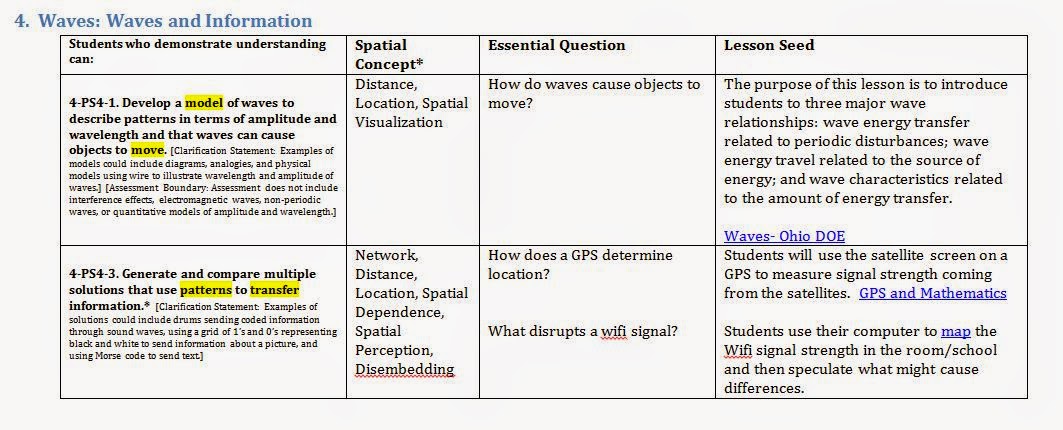
What Is So Spatial About the NGSS? A Curriculum Steeped in Spatial Thinking (Part 3)

In 2006, Learning to Think Spatially was published by the National Research Council.  Among its six recommendations was for the creation of spatial thinking standards based on existing content standards (National Research Council, 2006).  The goal is to allow students to develop spatial thinking in the context of relevant content.  While spatial standards have not been developed, current standards can be mined for spatial opportunities.  The Next Generation Science Standards (NGSS) offer a unique opportunity to develop spatial thinking in the context of a STEM education.

The integration of spatial thinking into science curriculum is a natural fit.   Many learning activities lend themselves to spatial thinking.  The example shown  requires spatial visualization.  In this case, students were asked to construct the blades of a windmill in order to turn the axle and pull up a cup full of washers.  To be successful, students needed to visualize how the air currents would flow across the blades of their windmill.  Aligning the blades so the flat side is facing the air current does not turn axle nor does turning the blades so the edge is facing the current.  Students have to realize that the blades must be an an angle.  Optimizing this angle produces greater rotation strength.


The primary difficulty of integration is not finding activities that require spatial thinking. There are plenty of rich science activities that are dripping with spatial connections.  The problem is determining the developmental appropriateness of these activities that has slowed many efforts at integration.  To overcome this dilemma and start the integration process, a matrix was created (sample at the end of the document).  This matrix listed each of the elementary performance expectations (PE) in grades kindergarten through grade five (ages 5-10 respectively) of the NGSS.  Spatial vocabulary within each PE is highlighted.   Using this as a starting point each PE was classified using the lists of spatial thinking skills below.

Abstract Cognitive Skills
Geospatial Skills
  • mental rotation
  • disembedding
  • visualization
  • perception
  • perspective taking

  • location
  • distance
  • region
  • network
  • overlay
  • scale
  • heterogeneity
  • dependence
  • objects
  • fields


Spatially focused essential question were developed and used as a filter for creating lesson seeds.  Lesson seeds consist of a broad overview of an activity idea and, where appropriate, associated resources.  Using this method, 62% of the PEs had spatial connections. Work will continue to expand on this initial analysis to broaden the scope of spatial connections.  This document will be used as a guideline for curriculum developers as they create a full elementary science curriculum aligned to the NGSS.


If you are interested in receiving the fall "Next Generation Science Standards Spatial Integration Matrix" please contact me and I will be happy to email it to you.  

Monday, April 21, 2014

What Is So Spatial About the NGSS? (Part 2)

During my last post, I laid out my argument for why we should think about the NGSS in spatial terms.  So now the obvious question is "So what?".  Why should we teach our students to think spatially?  Can it even be done?  Aren't these abilities set at birth?  


The ability to conceptualize the world in spatial terms has been strongly linked to success in science, technology, engineering, and math (STEM) related careers. A longitudinal study published in 2009 (Wai, 2009) details 50 years of research that solidifies this relationship. It showed that students with high spatial 
ability tended to choose STEM related careers at a very high rate.  As with many intellectual abilities, the perception that spatial ability is a fixed set of mental attributes has been overturned. Several studies have shown that a  student’s spatial ability can be cultivated through practice and meaningful application (Lee, 2009; Lubinski, 2010; Levine, 2005; Sorby, 2006) . However, spatial thinking has been largely ignored by public education with a focus on verbally or lecture based instruction being the norm. When spatial thinking is discussed, it is often maligned as a skill set relegated to trades and industries (i.e. carpentry, plumbing, welding, masonry, automotive repair) and not worthy of intellectual pursuit. However, some of the best minds of our time can trace their successes to the application spatial thinking. Albert Einstein once said that “The words or the language, as they are written or spoken, do not seem to play any role in my mechanisms of thought” and later concluding that his thoughts “are more or less clear images.” Nikola Tesla, a dynamic inventor who created the basis for alternating current, was rumored to be able to mentally build his inventions and visualize the working parts (Chandrasekhar, 2006). The reality of DNA’s double helix could not have been conceptualized except for the spatial cognition of Watson and Crick. However, as can be deduced from the examples given, there is a perception that ability to conceive of objects and their relationships in space is a white male dominated trait. This then begs the question of whether underrepresented populations (female, African-American, and Hispanic) in the STEM fields possess the capacity for spatial thinking and if so, what hinders its expression?

Several recent studies have concluded that the limiting factor influencing success in STEM programs regardless of sub-group is a lack of access to spatially related activities (Ault, 2010; Dixon 1995; Sorby 2012; Study 2004). Given the opportunity to think spatially, underrepresented populations perform as well as majority populations. It can therefore be speculated that the achievement gap cannot be overcome until the opportunity gap is overcome.


Ault, H., & Samuel, J. (2010). Assessing and Enhancing Visualization Skills of Engineering Studetns in Africa: A Comparative Study. Engineering Design Graphics Journal, 12-20.
 
Chandrasekhar, R. (2006, August 27). Chandrasekhar. Retrieved May 5, 2011, from Reflections on the Mind of Nikola Tesla: http://www.ee.uwa.edu.au/~chandra/Downloads/Tesla/MindOfTesla.html
 
Dixon, J. K. (1995). Limited English Proficiency and Spatial Visualization in Middle School Students Construction of the Concepts of Reflection and Rotation. The Bilingual Research Journal, 221-247.
 
Janelle, D. G. and M. F. Goodchild (2011). Concepts, Principles, Tools, and Challenges in Spatially Integrated Social Science. In Nyerges, T.L., H. Couclelis, and R. McMaster (Eds.) The Sage Handbook of GIS & Society. Sage Publications. pp 27-45
 
Lee, Jongwon; Bednarz, Robert. Effect of GIS Learning on Spatial Thinking Journal of Educational Psychology. v33 n2 p183-198 May 2009
 
Lubinski, D. (2010). Spatial ability and STEM: A sleeping giant for talent identification and development. Personality and Individual Differences, 344–351.
 
National Research Council.  Learning to Think Spatially: GIS as a Support System in the K-12 Curriculum. Washington, DC: The National Academies Press, 2006. 1. Print.
 
Susan C. Levine, Marina Vasilyeva, Stella F. Lourenco, Nora S. Newcombe, and Janellen Huttenlocher.  Socioeconomic Status Modifies the Sex Difference in Spatial Skill Psychological Science November 2005 16: 841-845, doi:10.1111/j.1467-9280.2005.01623.
 
Sorby, S. Gender Differences in Spatial Reasoning Skills and Their Effects on Success. http://www.edweek.org/site/News/Eweek/2006_marathon/BuildingSkills_2.ppt
 
Sorby, S. (2012). AC 2012-3305: Spatial Skills Among Minority and International Engineering Students. American Society of Engineering Education.
 
Study, N. E. (2004). Assessing Visualization Abilities in Minority Engineering Students. American Society of Engineering Education Annual Conference & Exposition (p. 11). Petersburg: American Society for Engineering Education.
 
University of Redlands. (2013). About LENS. Retrieved November 25, 2013, from LENS: http://lens.spatial.redlands.edu/?page_id=1118
 
Uttal, D. H., Meadow, N. G., Tipton, E., Hand, L. L., Alden, A. R., Warren, C., & Newcombe, N.S. (2012, June 4). The Malleability of Spatial Skills: A Meta-Analysis of Training Studies. Psychological Bulletin. Advance online publication. doi: 10.1037/a0028446

Wai, J., Lubinski, D., & Benbow, C. P. (2009). Spatial Ability for STEM Domains: Aligning Over 50 Years of Cumulative. Journal of Educational Psychology, 817-835

Wednesday, April 16, 2014

What Is So Spatial About the NGSS? (Part 1)

Over the last seventeen years,  I have integrated geospatial technologies into my science instruction.  As a high school environmental science teacher and elementary teacher, I have watched students grasp complicated patterns and complete complex tasks.   When I was presented with the opportunity to write an NGSS based curriculum for elementary, I knew geospatial technologies would be part of it, but I did not know where to put it. I then read the practices in the NGSS:


Developing and using models explicitly demands spatial reasoning to comprehend.  In many cases, the scale of a model (solar system, cell, atom) is manipulated to ease understanding.  We also use models to explain geologic phenomena such as tectonic plate movement.  In this case, the learner has to mentally "see" the movement of the plates.   


The act of mentally visualization is spatial thinking or reasoning in its purest form.  A more thorough definition was developed by Diana Sinton.

An ability to visualize and interpret location, position, distance, direction, relationships, movement, and change over space. 

She just published a wonderful book that offers an easy introduction to the topic called "The People's Guide to Spatial Thinking".  


Friday, April 4, 2014

Coming Out of the Fog: Getting Clarity on NGSS Unit Structure

I have had the opportunity to meet several members of the NGSS writing team at the NSTA conference.   So, you know me, I started asking them with questions.  

  1. How were the topic pages organized (this has preoccupied me for months)?  The most logical response has been that through the process of development, the team joined the PEs that would hang together under a theme.  
  2. Were specific culminating events/performances in  mind when they organized the PEs?  No, they were specifically told not to do that.  The committee did not want to appear to dictate curriculum.
  3. I asked about my proposed structure of using the topic pages as the basis for units.  The major concerns were student endurance and force fitting.  Looking at some of the unit lengths, I can see the endurance issue.  The grade 3 "Forces and Interactions" topic pages is going to be a long unit.   
  4. This particular page  brings me to something that I have been feeling lately as I watch the direction of some of the unit outlines my team is developing.  So, here is the revised plan.  If it fits and is logical, write it as one unit (see "Bee and Engineer").  If it feels forced, make it one storyline but with "sub-units" with specific performance assessments.  
My current curriculum has an example of this idea.  Last year, we re-developed a unit that had some serious implementation issues.  It covered Newton's Laws and for unknown reasons also included light (reflection, refraction).  The masterful writing team created a unit scenario focused on the Orion Deep Space System.  Students built straw rockets to demonstrate their understanding of Newtons Laws.  Part 2 of the unit, challenged students to create a "visual docking system" for the crew module (aka Periscope).   See image below.  The astronaut sits in the position shown but has to see out the window.  Build a device that will allow the astronaut to see out the window in order to dock if the ISS.  


Thursday, April 3, 2014

Coming Live from the NSTA Conference (part 1)

Here is your design idea for the day.  Make a hat that protects you from a specific type of weather.  After it is built, your partner has to guess what weather it is made for based on evidence.  Here is my hat.  Connects to the K. Weather and Climate-  Use tools and materials to design and build a structure that will reduce the warming effect of sunlight on an area.*


Monday, March 31, 2014

Hitting the Air Waves

I had the great fortune to participate in Lab Out Loud, NSTA's podcast for teachers and by teachers.  It was such a hoot talking with Dale and Brian having listened to them for the last couple of years on my commute to work. You can listen to the interview here are at the Lab Out Loud site.


Saturday, March 29, 2014

Bee an Engineer Part 2: Develop a simple model that mimics the function of an animal in dispersing seeds or pollinating plants.

It is hard to believe sometimes that I get paid for this job.  This past Friday, I was allowed to jump in and play with the kids at one of our local elementary schools. The second grade students were getting ready to build their first hand pollinator as the culminating event to "Bee an Engineer".    It was such a blast to see the creative sparks flying.  The lesson is as near a perfect match, as I have ever seen, to a "standard" or in this case a performance expectation (See below).


That is all I will say.   Watch the video and enjoy.


Saturday, March 22, 2014

To Boldly Go...

Please excuse the blatant Star Trek reference, but I could not help myself.   I had the opportunity to conduct observations of my STARLAB teachers this week.  STARLAB is our portable planetarium system.  We upgraded our system to the full digital version last year and in reality created our school system's first fully digital classroom.  There is very little that this system cannot do that a conventional "brick and motor" planetarium cannot do.  The one major difference is that ours does not come with the overly comfortable chairs.  We have carpet squares instead.  Not that the kids mind.  From preK-5, I have never observed students in the STARLAB where OOoooo's and Ahhhh's were not common.  It is simply one of the best examples of an immersive environment.  


As I sat and watched the lesson take place, my mind drifted to the NGSS.  What role with the STARLAB have in an NGSS based curriculum?  Traditional planetarium programs are mostly presenter/teacher centered.  The audience typically is a passive participant. Let's start by looking at the grade one "Space Systems" performance expectations.

Students who demonstrate understanding can:
1-ESS1-1.Use observations of the sun, moon, and stars to describe patterns that can be predicted. [Clarification Statement: Examples of patterns could include that the sun and moon appear to rise in one part of the sky, move across the sky, and set; and stars other than our sun are visible at night but not during the day.] [Assessment Boundary: Assessment of star patterns is limited to stars being seen at night and not during the day.]
1-ESS1-2.Make observations at different times of year to relate the amount of daylight to the time of year. [Clarification Statement: Emphasis is on relative comparisons of the amount of daylight in the winter to the amount in the spring or fall.] [Assessment Boundary: Assessment is limited to relative amounts of daylight, not quantifying the hours or time of daylight.]
How would these expectations be realized in a regular classroom?  On a literal interpretation, the implication is that these two performance expectations would take most of a school year to master.  Some of these patterns occur within one 24 hour cycle and some require an entire year to observe.  Enter the STARLAB.  One of the great benefits of the STARLAB is the ability to control time.  An entire year of patterns can be compressed into minutes or seconds.  Students can watch where the sun rises and sets throughout the year for our latitude (39 degrees North) or the cycle of the moon phases.  This becomes a real exercise in observation for students.  They would be able to watch the motion and make predictions about what the movement means and what implications it has for day length.   This is also a great math connection.  With the digital planetarium, a clock can be virtually mounted to the sky.   I feel very fortunate that our school district has these systems because I'm not sure how we would meet these performance expectations without them. 

We currently have two of these systems.  During the course of a school year, they are able to visit 1/3 of our schools (roughly 34+/-).  That means the STARLAB will visit a school every three years.  So now the conundrum.  If STARLAB is the best way to teach these performance expectations, then how do we insure every student has a chance to participate.  The second set of Space System performance expectations occurs at grade 5:

Students who demonstrate understanding can:
5-PS2-1.Support an argument that the gravitational force exerted by Earth on objects is directed down. [Clarification Statement: “Down” is a local description of the direction that points toward the center of the spherical Earth.] [Assessment Boundary: Assessment does not include mathematical representation of gravitational force.]
5-ESS1-1.Support an argument that differences in the apparent brightness of the sun compared to other stars is due to their relative distances from the Earth. [Assessment Boundary: Assessment is limited to relative distances, not sizes, of stars. Assessment does not include other factors that affect apparent brightness (such as stellar masses, age, stage).]
5-ESS1-2.Represent data in graphical displays to reveal patterns of daily changes in length and direction of shadows, day and night, and the seasonal appearance of some stars in the night sky. [Clarification Statement: Examples of patterns could include the position and motion of Earth with respect to the sun and selected stars that are visible only in particular months.] [Assessment Boundary: Assessment does not include causes of seasons.]
Given the book ends of grade 1 and 5, our plan is teach have these units when the STARLAB is scheduled to come to a school.  Everyone in grades K-2 will teach the grade one unit.  Everyone in 3-5 will teach the grade 5 unit.  Obviously, there will need to be some significant modifications of language to meet the expectations for each grade level, but I am confident it can be done.  

My last dilemma is what Starfleet designation is most appropriate for STARLAB.  I am planning to paint the call letters on the side.  What do you think?  NCC-?????


Monday, March 17, 2014

Rough Estimates of Unit Lengths

Based on my last post, I figured out that I could estimate the length of each unit based on some assumptions:

  • Unit opens with one day for preview/preassessment
  • The second lesson requires students to develop a prototype/solution and reflect on preassessment data
  • Each performance assessment needs at least three lessons in order for students to demonstrate mastery
    • One lesson to understand the practice by having students apply it to prior knowledge
    • One lesson to understand the DCI (content)
    • One lesson to combine them together
  • A lesson where students revise their prototype/solution as a culminating event

Using this logic, just for the purposes of estimating unit lengths, I can quickly deduce the range of teaching time based on a 30-60 minute per day structure.  


Grade-Unit
PEs
Lessons
Days
K-Forces
2
9
9-18
K-Relationship
4
15
15-30
K-Weather
4
15
15-30
TOTAL
10
39
39-78
1-Light
4
15
15-30
1-Function
3
12
12-24
1-Space
2
9
9-18
TOTAL
9
36
36-72
2-Structure
4
15
15-30
2-Interdependent
3
12
12-24
2-Earth
4
15
15-30
TOTAL
11
42
42-84
3-Forces
4
15
15-30
3-Ecosystems
4
15
15-30
3-Traits
4
15
15-30
3-Weather
3
12
12-24
TOTAL
15
57
57-114
4-Energy
5
18
18-36
4-Waves
2
9
9-18
4-Structure
3
12
12-24
4-Earth
4
15
15-30
TOTAL
14
54
54-108
5-Matter
4
15
15-30
5-Ecosystems
3
12
12-24
5-Earth
3
12
12-24
5-Space
3
12
12-24
TOTAL
13
51
51-102